Blog
KING VULTURE
The most beautiful vulture of the New World
January 16, 2024
The first time I saw a King Vulture (Sarcoramphus papa) in Peru, I was starstruck. Little did I know about vultures, they don’t live in the part of the world where I was born (the Netherlands). The preconceived notions that I had, of vultures being “dirty” dead animals’ eaters and not the prettiest ones in the bird realm, were completely disproven once I saw the King Vulture through my binoculars. What a fantastic piece of nature’s art! The colors, the size, the elegant white feather coat. How does it stay so white and clean with these eating habits?! Why the extremely colorful head and fleshy wobbling knob at the bill?
In this blog we will share some interesting facts about this magnificent bird. And some photos of course, taken in one of the only two places in the world where it is possible to photograph the King Vulture from a hide: the beautiful garden Mirador Pico de Hoz in Manu National Park, Peru. More about this garden later, first a little dive into the world of the King Vulture.
The Americas are home to seven species of vultures (family Cathartidae), including five vultures and two condors. The New World vultures are not genetically closely related to the Old World vultures (family Accipitridae), although they are similar in appearance and behavior. The evolution of both vulture families occurred independently, adapting in similar ways to their environments.
The King Vulture is one of the New World vultures and without doubt the most striking, with its colorful head and wingspan of nearly 2 meters. Its white feather suit with black boards and a dusky gray ruff at the base of the neck, probably reminded the Swedish biologist Carl Linnaeus of a bishop’s rope. He gave the vulture the species name Vultur papa, papa meaning bishop in Latin. In 1805 the French zoologist André Marie Constant Duméril renamed the genus Sarcoramphus: “flesh + bill of bird of prey” in Greek.
One of the most distinctive features of the adult King Vulture is the bare skinned head and neck, with skin folds in vivid colors of reds, oranges, yellows, and purple. The eyes are piercing white and it has a pink pendent crop. At the base of the bill, it has an orange red “caruncle”, a fleshy part of skin that flaps sideways when the vulture moves its head. Most birds’ caruncles are used to attract mates, but since King Vulture males and females look largely similar, the exact purpose of its caruncle isn’t yet fully understood. Young birds are entirely dark, and it takes four to five years to attain gradually the adult plumage and colorful head.
Like other vultures, the King Vulture is a scavenger. Its size and the fact that it has the most powerful bill of all American vultures, allows the King Vulture to be the first to dine on a carcass. It is able to rip open areas that the smaller vultures cannot. Carcasses ranging from dead fish, lizards, sloths, monkeys, up to cattle are on the menu. Some reports show that it occasionally kills small reptiles, wounded animals, and even newborn calves.
Vultures are nature’s sanitary engineers. They are helping to prevent the spread of disease by cleaning up carcasses quickly. And another preconception of vultures being “dirty” vaporized in thin air!
The King Vulture has a large habitat range from southern Mexico south to northern Argentina. It inhabits lowlands, dry and humid tropical forests, pre montane foothills, and generally keeps away from areas with human activity.
King Vulture Facts
King Vultures apparently lack a developed sense of smell, so they depend on other vultures to lead them to food.
They practice “Urohidrosis”: the habit of defecating onto the legs as a cooling mechanism. This habit might even work as an antiseptic wash to kill bacteria that they may have picked up while walking over their meals. Their digestive juices are extremely corrosive, allowing them to safely digest rotting carcasses infected with bacteria.
King Vultures are monogamous and both parents share incubation, brooding, and feeding responsibilities. A female King Vulture lays one single egg per nest on the ground or in a tree stump.
King Vulture parents try to keep the nest as stinky as possible by vomiting around it, to ward off predators.
Like other vultures, King Vultures do not have a voice box. They are unable to make calls or songs. However, they can produce guttural grunts and whistling hisses.
They are solitary birds and are seen in small groups or alone.
It is predicted that the population of King Vultures is less than 50,000. The population is in in decline due to habitat loss, and human practices like poaching. Still, the IUCN Red List status of King Vulture is evaluated as Least Concern.
There are two theories on how the King Vulture earned the “king” part of its name. The first is that the name refers to its dominant position in the feeding order, as explained above. The second theory is that the name is derived from Maya mythology, in which the bird was an important god who served as a messenger between humans and other gods.
King Vultures were important beings in the lives of Pre-Columbian indigenous peoples, like the Maya. They were often depicted in their art, mythology, and cosmology; associated with cleanliness, renewal, and the transformation of death into life.
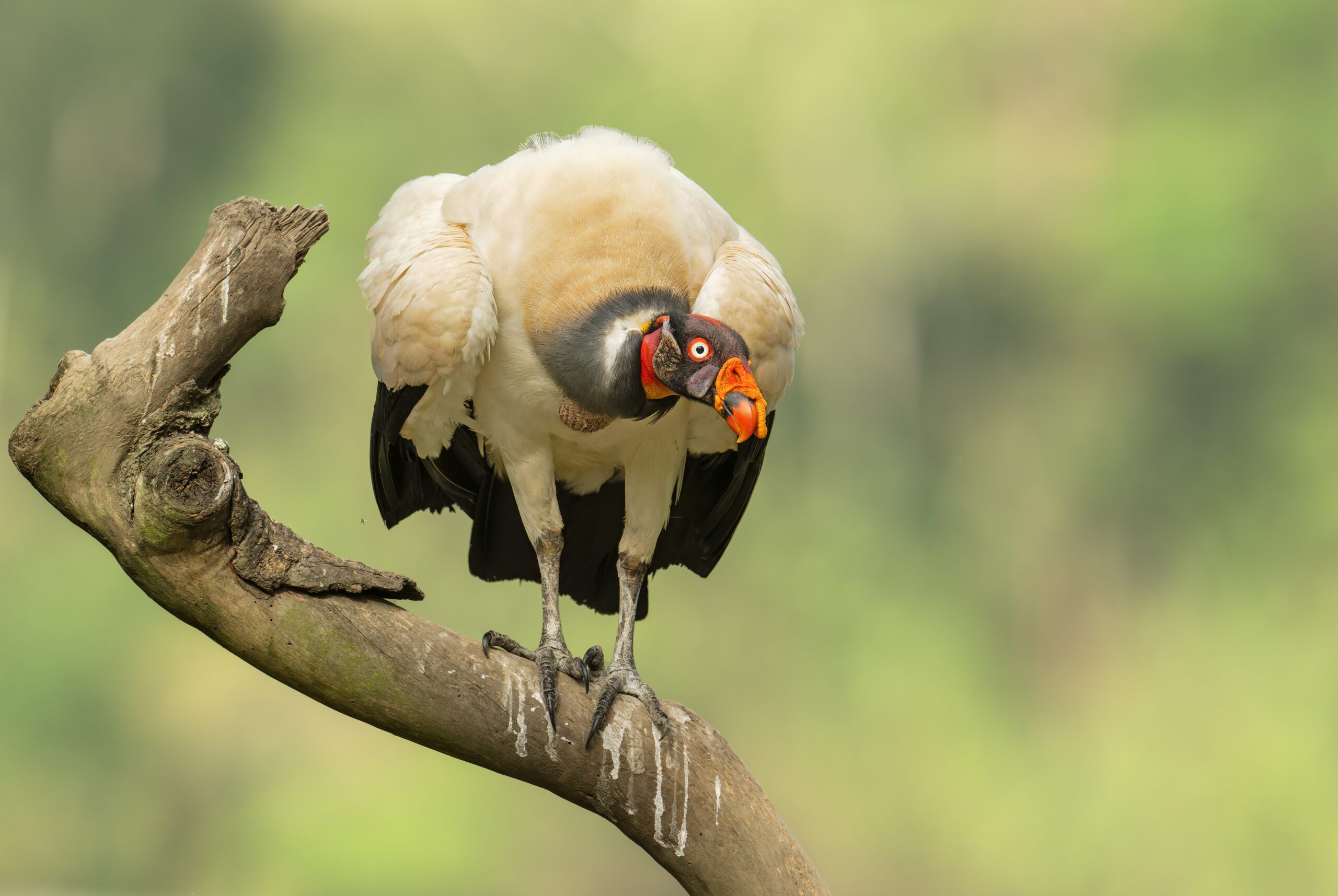
Would you like to see and photograph the King Vulture? During our birding and photography tours to Manu National Park, we will visit the garden Mirador Pico de Hoz. The hide in this garden offers fantastic and close (photo) opportunities for the King Vulture, and other vultures as well, like Greater Yellow-headed Vulture and Black Vulture. The garden is situated in Manu National Park, known for its great biodiversity, many species of birds and can be reached by car from Cusco within a few hours.
Are you interested in Peru’s rich Inca past as well? We also offer combined tours, with a visit to Machu Picchu. Tailor made tours are also possible. Please contact us if you would like to know more.
Written by Eva Wu – Photos by Steve Sánchez
Tours to see and photograph the King Vulture:
Birding tour to Manu National Park
Photography Tour to Manu National Park
Birding and Culture Tour Manu National Park
References:
Company Address:
Kuntur Nature and Adventure EIRL
Av. Industrial Conj. Hab. FOVIPOL. Nr 104
Santiago – Cusco – Peru
This website uses cookies to ensure security and improve functionality.
Kuntur Birding © 2026 All Rights Reserved