
Blog
Andean Condor
Giant of the Mountains and Sky
December 6, 2024
This blog is dedicated to one of the most evocative and iconic birds of the Andes after which our Peruvian travel agency is named: the Andean Condor. The name condor derives from kuntur in Quechua, the language of the Inca that is still spoken by more than a 10 million people in the Andes regions. The Andean Condor plays an important role in the folklore, mythology and spirituality of both ancient and Andean people today. For good and bad, as we will see in this blog.
World’s largest soaring bird – some facts
Condor is the common name for two species of New World vultures, each in a monotypic genus: the Andean Condor (Vultur gryphus) and the California Condor (Gymnogyps californianus). The habitat of the latter is restricted to the western coastal mountains of the United States and Mexico, as well as the northern desert mountains of Arizona.
The Andean Condor embodies the enormous distances and heights of the longest mountain range in the world. Its range used to stretch from the Andes in Venezuela all the way south to Tierra del Fuego. Unfortunately, the Andean Condor became a rare sight in much of the Andes north of Peru up to Venezuela.
As world’s largest and heaviest soaring bird, the Andean Condor can stay aloft for 5 hours and cover more than 160 km (100 miles) hardly flapping its wings. Researchers have found out that the condor flaps its wings just 1% of the time during flight. With a weight up to 15 kg and a wingspan between 260 and 320 cm, it effortlessly makes use of air currents to stay airborne, sailing over some of the tallest peaks in the world in search of carcasses of big mammals such as guanacos or domestic livestock. The condor also descends to the coastal desert plains of Peru and Chile to search for stranded whales, seals and seabirds. During the birth season, condors visit large seal colonies to feed on the placentas of recently born young.
Male and female Andean Condors look different from each other, contrary to other American vultures that don’t show sexual dimorphism. Male condors have large fleshy combs or caruncles on the crown of their heads which increase in size with age and large neck wattles, whereas females completely lack the comb and the folds of skin on the neck are variable. Adult males and immature females have brown eyes, adult females red. The plumage of both male and female is black, with greyish-white upper wing parts. Both have an elegant white ruff around the neck. The bare skin of the head and neck is variable in color, reddish pink at base of neck, more mottled greyish pink or yellow on the head. The color of the head and neck can change in response to the bird’s emotional state. The skin can become more yellow when the condors get agitated over food, for example. Or during courtship displays, the skin of the male’s neck flushes, changing from dull red to bright yellow, and inflates. He approaches the female with the neck outstretched, revealing the inflated neck and the chest patch, while hissing and dancing around the female with extended wings. The juvenile condor is dull brown, with dark bare skin. Over the years the plumage will become blacker, and the white neck-ruff only appears in adults. Fully adult plumage is only achieved when the condor reaches an age of around 8 years old. Another difference is that the female condor is smaller than the male, which is unusual in birds of prey where the female normally is bigger. They may live up to 50 years or more.

The Andean Condor prefers the high mountains, including high peaks of least 5000 meters, open grassland and alpine regions, away from human disturbance and where carrion can be found. With its powerful bill the condor is capable of tearing the skin of dead animals and extract the muscles and viscera from the carcasses.
Birds that mate for life typically have long lives, care for their young long after they leave the nest, have low reproductive productivity, are large, and take multiple years to reach sexual maturity. Andean condors meet these criteria exceedingly well, making them a prime example of birds that are monogamous and mate for life. Male and female condors seem to engage in courtship displays and copulate throughout the year, which is generally regarded to strengthen the pair’s bond.
Andean Condors are secretive nesters and place their nests at cliffs between 3000 and 5000 meters that are difficult to excess by predators and researchers. There is not much known about their breeding frequency and success. They are exceptionally slow breeders, only reproducing when they reach maturity at around nine years old and rearing a chick every two to three years. During the breeding season, one white and unmarked egg is laid and incubated by both sexes, which is unusual among most birds of prey where the female does most of the incubation. It takes 50 to 60 days for the egg to hatch. The chick grows slowly and is fully feathered and capable to fly at six months. The parents continue to care for their fledgling for at least four months more, thus the entire breeding season lasts more than 12 months.
Its conservation status classified by IUCN is Vulnerable to extinction. Since start of 21st century declines in the Andean Condor population have continued in Ecuador, as well as in Peru and Bolivia, but the species still appears to be numerous and stable in Argentina, with around 300 individuals in Northwest Patagonia. Causes for the decline of the population are collisions with powerlines, lead poisoning caused by ammunition in hunted animals, the use of living condors in traditional ceremonies in Peru like the Yahuar Fiesta that will be explained below, as well as persecution and poisoning, because the condor is thought to attack livestock, small children and pets. These ideas are fueled by sensationalized stories and exaggerations. Even though it is one of the biggest birds in the world, the condor lacks the physical strength and grasping power required to lift anything heavier than a few pounds. It is a rather passive scavenger that primarily feeds on carrion, rarely engage in active hunting, and poses no threat to humans or larger animals. As a scavenger with an extremely well-developed sense of smell, it has an important ecological role. By eating dead animals, the risk of diseases associated with slow rotting cadavers is diminished.
Kuntur in Andean mythology
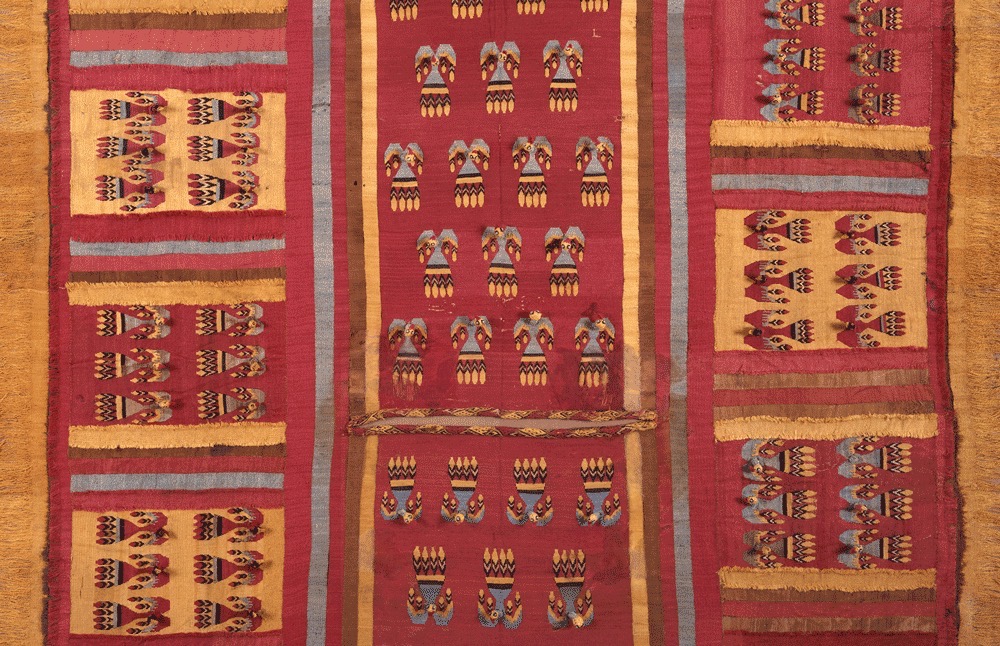
The Andean Condor plays an important role in the folklore, mythology, Cosmovisíon Andina (Indigenous Andean cosmic worldviews) and has been represented in the art (textiles, ceramics, paintings) of different Andean cultures from c. 2500 BCE onward. Kuntur is considered a symbol of power and health by many ancient and contemporary Andean peoples.
In Inca cosmovision and mythology, the Andean condor was associated with the sun deity Inti and was believed to be immortal and the ruler of the upper world known as Hanan Pacha in Quechua. Kuntur was a powerful messenger between Hanan Pacha and the realm human beings live in, Kay Pacha, on the surface of the earth. The Inca established the largest empire in pre-Columbian America from modern-day Colombia to Chile from 1438 until 1533, when the Spanish conquistador Pizarro and his men overthrew their power. The administrative, political, and military center of the empire was the city of Cusco in the high Andes of modern-day Peru.
The symbol of the condor has passed from one era to another, into the Andean culture and modern nation-states, as the embodiment of indigenous identity and to signify power and progress. Condors are displayed on the national coats of arms of Ecuador, Bolivia, Chile and Colombia, on stamps and commercial logos, as well as in music. The famous song ‘El Cóndor Pasa’ is performed by many different musicians like Daniel Alomía Robles, Los Incas, Ima Sumac, and Simón & Garfunkel (‘If I could’). Condorito, a Chilean comic character representing the Chilean people, is popular Latin American. In the Southern Andes the condor is still believed to be an ancestor god and one of the forms adopted by the mountain spirits or Apus in Quechua, when the latter are invoked by humans in ritual contexts.
The symbolism that is attached to the condor is also a product of the colonial process. During the Yahuar Fiesta or Blood Festival in the Apurimac region in Southeast Peru, for example, the villagers celebrate independence from Spanish colonial rule. The event that occurs every year in July, attracts villagers and local tourists to witness a life-or-death struggle of a wild Andean Condor, symbolizing the resisting Inca people, that is tied to the back of a bull, representing the Spanish conquistadores. A bullfighter spurs the two scared animals into a bloody fight, and he eventually kills the bull. The condor is usually set free after the fight, but it is unknown whether it survives. It is estimates that around 60 wild Andean Condors are trapped every year for the spectacle. The birds are kept in unsafe conditions for several days, paraded through the streets, and fed alcohol before the main event. Although Peruvian law forbids the capture of wild animals, the festivals are carried out under the leadership of local mayors, police, and priests.
The USA based NGO The Peregrine Fund who is partnering with the Peruvian NGO CORBIDI states that many people are not aware that the Yahuar ceremony harms or kills the condors. Local Peruvian communities see the Andean Condor as sacred, symbolizing a god descending from the heavens to fight in their behalf. Because condors fly vast distances, it is likely that the Yahuar Fiestas affect the entire condor population. The global population is very roughly estimated to consist of 10,000 individuals (BirdLife International, 2001), of which 6700 are considered mature individuals. Peru only holds a minimum of 150-250 individuals (BirdLife International).
The condor’s body parts also entered the realm of human believes. It is thought that the bones and organs of the condor possess medicinal powers, leading to hunting and killing of the birds. Their ground bones are believed to alleviate rheumatism. The eyes of the condor are roasted and eaten to sharpen one’s sight and the feathers are placed under sleeping blankets to ward off nightmares. Unfortunately, these practices still happen today.
But luckily, there is also good news. Scientists, conservationists, and Indigenous communities joined hands to help to protect the iconic vulture. The Andean Condor Conservation Program (PCCA) has been leading condor force in Argentina for three decades. Their conservation program has rescued at least 370 condors and has hatched and released 80 condor chicks. Thanks to this program, PCCA has reestablished Andean condors along the Atlantic coast of southern Patagonia. Scientists with PCCA are using GPS-tracking collars to follow the birds once they return to the wild. The data allows them to identify key habitats and educate policymakers about which areas should be targeted for protection.
Andean peoples experience a deep connection with the condor, as the “spirit of the Andes”. Every time PCCA releases a condor, local communities host a unique ceremony with prayers, led by a spiritual leader, to celebrate the bird’s return into its natural world. Spiritual leaders of the Indigenous communities throughout Argentina are not only involved only in the ceremonial condor releases, but are also critical team members for condor rescue, rehabilitation, and education.
The condor’s impressive wingspan and remarkable flight capabilities to soar at great heights may almost seem supernatural and have inspired the imagination of us humans through time. The Andean Condor is indeed a wonder of natural evolution adapted to the extreme Andean environment. Hopefully we will be able to continue to admire this magical bird in different ways. To end with the words of Luis Jácome, director of the PCCA: “Today, we are living in conflict. There must be a return to the natural order.”
We offer several tours to observe Andean Condors in their natural habitat in the Andes Mountains:
Central Peru Birding Tour – 17 days
Condors of Chonta Canyon, Cusco Peru – 2 days
Please contact us if you would like to know more about the tours.
Written by Eva Wu – Photos by Steve Sánchez
References:
Company Address:
Kuntur Nature and Adventure EIRL
Av. Industrial Conj. Hab. FOVIPOL. Nr 104
Santiago – Cusco – Peru
This website uses cookies to ensure security and improve functionality.
Kuntur Birding © 2026 All Rights Reserved