
Trip Report
Birds of the Amazon River - Iquitos Peru
Allpahuayo Mishana & Muyuna Lodge
7 - 14 February 2025
June 25, 2025
On the 7th of February 2025 we (Steve, Eva and our birding friend Rocio from Spain) embarked on a 1,5-hour flight from Lima to Iquitos in northeastern Peru, to explore the different habitats of the Upper Amazon River, including river islands and white sand forests. This area is known to be one of the richest areas in bird species in the entire vast Amazonian basin, with over 600 recorded species, many of them endemic and specialized to live in these restricted and unique habitats, like Wattled Curassow, Chestnut-belted Gnateater, Pavonine Quetzal, Black-necked Red-Cotinga, Undulated Antshrike, Zimmer’s Woodcreeper, Paple-billed Hornero, White-bellied Spinetail, Black-and-white Antbird, Olive-spotted Hummingbird, Parker`s Spinetail. Not far from Iquitos, two major rivers, the Marañon and Ucayali, meet and form the majestic Amazon River, creating a variety of different habitats, including river islands. The river forms a natural limit, as the northern Amazon River side has different bird species in comparison to the southern side.
Our flight to the city of Iquitos was quick and smooth. Peru is big and there are many flight connections from Lima to the different cities in the country, all of them reachable within 2 hours by plane. Iquitos is located in the Amazon Basin and surrounded by the Amazon, Nanay, and Itaya rivers. It was founded during the rubber and timber boom of the 19th century and is the largest city in the world that is only accessible by river and air, since there are no road connections. It is the biggest city in the Peruvian Amazon and together with the smaller city of Tarapoto, the doorway through which many national and international tourists visit the vast Amazon jungle.

Allpahuayo Mishana Reserve
We landed at night in Iquitos and as we stepped out of the plane, a warm and humid jungle blanket wrapped itself around us. We stayed one night at Victoria Regia Hotel in Iquitos where we had a quick dinner. The next morning our taxi driver brought us to the Allpahuayo Mishana Reserve, located 2 hours by car from Iquitos. This newly created reserve protects the largest concentration of white-sand forest so far known in the Peruvian Amazon. It is famous for its rare and unique bird species. Although it is a challenge to find the scarce birds in the white sand forests which are poor in nutrients, we started our exploration with high hopes and a positive mind. We were accompanied by local guide who, with his keen eyes and knowledge of the area, spotted within 5 minutes a couple (male and female) of Allpahuayo Antbirds. This rare antbird is endemic to the white sand forests in Northeastern Peru and only described by science in 2001.
We continued our walk in the dense forest where we had nice moments with a charismatic Yellow-billed Jacamar, Ancient Antwren, Starred Wood-Quail, Many-banded Aracari, Dusky-headed Parakeet, Mouse-colored Antshrike, Saturnine Antshrike, Plain-throated Antwren, White-flanked Antwren, Peruvian Warbling-Antbird, Wedge-billed Woodcreeper, Buff-throated Woodcreeper, Blue-capped Manakin, Black-crowned Tityra, Ochre-bellied Flycatcher, Piratic Flycatcher, Sulphury Flycatcher, Russet-backed Oropendola, and we heard a Cinereous Tinamou calling.
During our 2-hour walk, we saw 23 species, and despite the rain, we enjoyed the white sand forest of Allpahuayo Mishana and its birds a lot. We would have loved to see the elusive Iquitos Gnatcatcher that hasn’t been seen for several years. We weren’t lucky either. Our driver brought us back to Iquitos where we had a local dinner in one of the restaurants at the main square.

9 February – The next morning, we were picked up at our hotel by a driver who was working for Muyuna Lodge for a 2-hours transfer by van to a small town located at the shore of the Amazon River. We embarked on a fast boat that would take us to our next accommodation, the beautiful ecolodge Muyuna located at the south bank of the Amazon River. The one-hour boat ride over the majestic Amazon was spectaculair as the river was very broad at the point where we crossed it from one side to the other. We passed the large river island of Buenos Aires that we were to visit in the next days. After crossing the Amazon, we entered a small side river, where we saw our first Amazon River Dolphin, also called Pink River Dolphin! These dolphins apparently like to look for food where the small river meets the Amazon River, because we would see them at the same point on other moments during our stay. We passed some small communities with wooden houses on high poles to keep them safe from the water that during the rain season can rise several meters. In the endless green forest flanking the waterways, we saw different colorful birds, like noisy Horned Screamers, Wattled Jacanas, macaws flying over, and a Black-collared Hawk, or Mama Vieja (Old Mother) like the local people call the bird because of its whitish head and raspy voice. As the boat also transported other passengers, we couldn’t do birding stops during the transfer to the lodge.
Amazon River
Before we continue this trip report, some remarkable facts about the Amazon River. It is, for example, the greatest river of South America and the largest drainage system in the world in terms of the volume of its flow and the area of its basin. The total length of the river—as measured from the headwaters of the Ucayali-Apurímac River system in southern Peru—is at least 4,000 miles (6,400 km), which makes it slightly shorter than the Nile River. Its westernmost source is high in the Andes Mountains, within 100 miles (160 km) of the Pacific Ocean, and its mouth is in the Atlantic Ocean, on the northeastern coast of Brazil. The vast Amazon basin (Amazonia), the largest lowland in Latin America, has an area of about 2.7 million square miles (7 million square km). The basin includes the greater part of Brazil and Peru, significant parts of Colombia, Ecuador, and Bolivia, and a small area of Venezuela. The extensive lowland areas bordering the main river and its tributaries, are called várzeas (“floodplains”), due to annual flooding which enriches the soil. However, most of the vast basin consists of upland, well above the inundations and are known as terra firme. More than two-thirds of the basin is covered by an immense rainforest, which grades into dry forest and savanna on the higher northern and southern margins and into montane forest in the Andes to the west. The Amazon Rainforest represents about half of the Earth’s remaining rainforest. The first European to explore the Amazon, in 1541, was the Spanish soldier Francisco de Orellana, who gave the river its name after reporting battles with tribes of “female warriors”, that reminded him of the Amazons from Greek myths. In Peru the upper mainstream (fed by numerous tributaries flowing from sources in the Andes) down to the confluence with the Ucayali River is called Marañón, and from there to the Brazilian border it is called Amazonas. In Brazil the name of the river that flows from Peru to its confluence with the Negro River is Solimões; from the Negro out to the Atlantic the river is called Amazonas. The diversity of Amazonian flora and fauna is unprecedented. The discovery of new species of plants and wildlife today is far from rarity. More than 8,000 species of insects alone have been collected and classified, among them spiders, beetles and mantids. Which makes the possibilities for macro photography infinitive.
The Peruvian Amazon Rainforest houses more than 2,000 species of birds and 250 aquatic species; this number increases seasonally with migratory birds from Patagonia and North America.


After arriving by boat at the Muyuna Ecolodge, we were welcomed by the sounds of many Russed-backed Oropendulas and Yellow-rumped Caciques, who made their characteristic hanging nests in a big tree close to the lodge buildings. Santiago Sanchez Sarfati, the manager of Muyuna, was there to welcome us as well and showed us around. The lodge is beautifully located at the Yanayacu river, a small tributary of the Amazon River, 140 km upriver from Iquitos, in the Tamshiyacu Tahuayo Regional Conservation Area. The reserve was established to preserve the ecosystems of the upland, the Varzea Forest and to support the sustainable use of the wildlife by the local population. The area is known for its high biodiversity. Hundreds of species of mammals, primates, birds, fish and reptiles have been documented, including several that are endemic as well as either endangered or threatened. It is also an important flyway of migratory birds that are coming from North America. Around Muyuna more than 450 species of birds are registered, which makes it a paradise for birders.
We were shown to our cabins, beautiful wooden constructions with high roofs and standing on high poles, safe from the rising river in the rain season (November – April). The individual cabins have a clean and spacious bathroom with a toilet and warm water shower. The cabins are decorated inside with a beautiful wall painting of local birds, a comfortable bed, a ceiling fan that runs off solar and balcony with seats, a hammock and river view. The cabins are covered with mosquito nets to keep the lively insect world outside. We had a delicious lunch buffet in the big and charming dining area, with tasty alternatives for the vegetarians amongst us. Coffee, tea, hot chocolates, snacks, fruits are 24/7 available on a table in the dining area.
After lunch we were introduced to our local birding guide at Muyuna, Francisco. We were given rubber boots to use and sprayed ourselves with insect repellent, ready for our first walk along the trails around the lodge. Our guide Francisco, who has great knowledge about the birds in the area and a good eye, showed us a nice Great Potoo resting in one of the big trees close to the cabins. We took some time as well to photograph a tame Horned Screamer that was foraging for snacks on a thick carpet of aquatic plants close to the boat house. The trails around the lodge were muddy of the rain, so we were very happy with the rubber boots. Close to the lodge we saw the head of a Bamboo Rat with black marble eyes peeking out of a tree hole. Bird species we saw were Black-fronted Nunbird, Chestnut-eared Aracari, Black-tailed and Amazonian Trogon, until the rain stopped us from going further.
After dinner the rain had stopped, and we went out by boat under a starry sky to the search the waterways around the lodge. How different the world is at night with all the jungle sounds! We found Common Pauraque, Boat-billed Heron, Cocoi Heron, a beautiful Spectacled Owl and many fishing bats. We tried out our new Zeiss thermoscope, which seemed to work very well. We saw monkeys (too far to identify the species) and Bamboo Rats walking along tree branches through the thermoscope, that were otherwise impossible to detect with only a flashlight and binoculars. We slept very well that night in our comfortable cabin accompanied by thousands of singing insects.
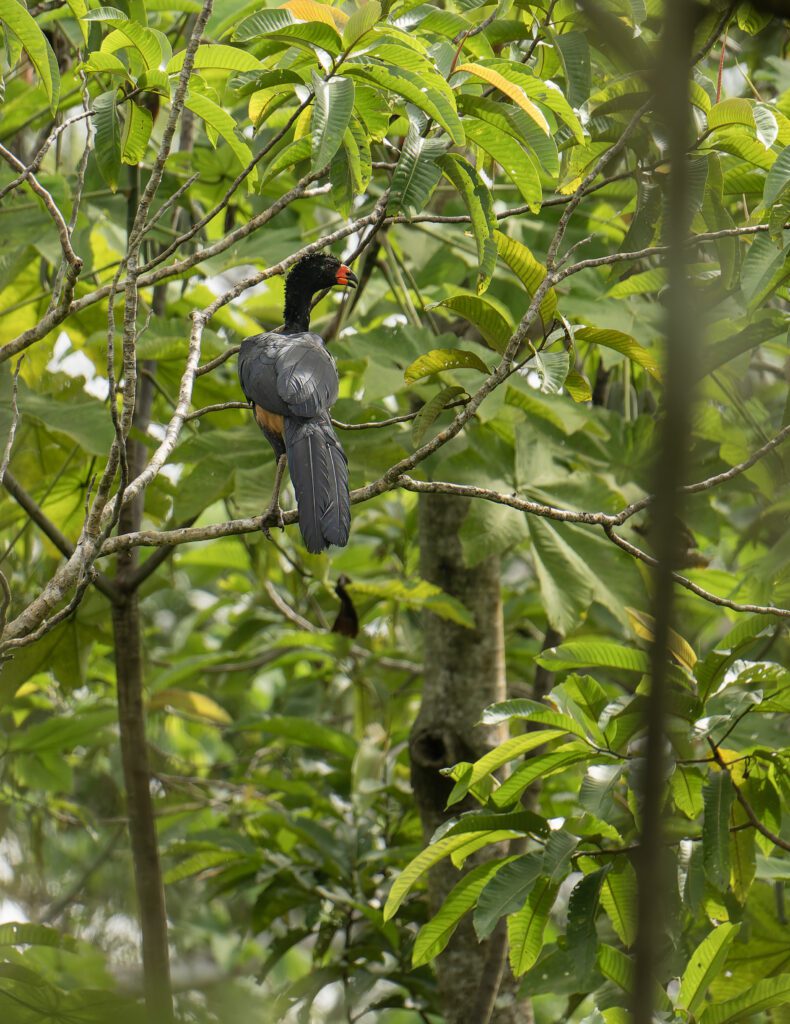

10 February – The next morning, we went for another boat ride with our guide and boat driver, exploring the rivers and lakes close to the lodge. We saw 60 bird species, making it a very fruitful morning. The highlight of the morning, although far away (too far for photos) and hidden between branches and leaves, was a male Wattled Curassow. This area is one of the best places to see this illusive and endangered species.
Wattled Curassow
The Wattled Curassow is a large, mainly black, terrestrial cracid, with curled crest feathers and a white vent. The black bill has a reddish cere, knob and wattle. The female is black with a rufous vent and lacks the wattle.It inhabits humid lowland, riverine forest, especially seasonally flooded areas, where it forages in small groups for small fish, insects, aquatic crustaceans, other small animals and fruit. Little is known about its behavior, breeding and foraging habits. The Wattled Curassow was formerly widespread in upper Amazonia, western Brazil, southern Colombia, and eastern Ecuador to northern Bolivia. It is now estimated that less than 300 individuals are left in Peru, 320 in Colombia, 100–150 in Bolivia and perhaps as many as 1000 individuals in Brazil. Precise reasons for the extreme scarcity of these recent records remain unclear, despite the known problem of intense hunting for food and for bird trade, and the destruction of areas of várzea forest in Brazilian Amazonia and the alteration of riverine habitats elsewhere.
The fact that there are just a few remaining, its size and photogenic appearance, made it a joyful and special moment for us to see this male Wattled Curassow. The trained ears and eyes of guide Francisco spotted another one and we had to embark from the boat and walk a bit through the forest in order to see it. Unfortunately, it had already left by the time we got to the spot. The short walk through the forest though, untouched by human hands, was also worth it.
Other interesting species that we saw this morning, among others, were Little Cuckoo, Blue-crowned Trogon, White-eared Jacamar, Lettered Aracari, Chestnut-eared Aracari, Spot-breasted Woodpecker, Long-billed Woodcreeper, Zimmer’s Woodcreeper, Red-and-white Spinetail, Bare-necked Fruitcrow, White-headed Marsh Tyrant, Orange-backed Troupial, Festive Amazon, 2 species of hummingbirds (White-bearded Hermit, Glittering-throated Emerald) and a variety of raptors such as Gray-headed Kite, Black Hawk-Eagle, Great Black Hawk, Laughing Falcon.
It wasn’t only birds that we saw that morning. A Brown-throated Three-toed Sloth was hanging in a tree close the river and the reddish colored head of a big Caiman Lizard peeked out of the aquatic plants as we boated by.
In the afternoon we went for another boat ride, where we could add American Pygmy Kingfisher, Bluish-fronted Jacamar and the beautiful Masked Crimson Tanager and Plum-throated Cotinga to our list.
Around dinner time, a heavy rain washed over, since we found ourselves in the middle of the rain season. A Tropical Screech Owl sought shelter on a beam of the high roof of the dining area. It didn’t stop raining that night, which made our cabin even more cozy and our sleep more profound.

11 February – When we woke up the next morning, we saw that the river had grown due to the heavy rain during the night. Fields of aquatic plants were floating by on the current. After an early breakfast we embarked on the boat again for a morning exploration accompanied by a concert of Horned Screamers. We also went ashore and walked along winding trails through a variety of jungle plants and trees, among them a huge Ceiba tree. We saw different species of puffbirds and antbirds: Chestnut-capped Puffbird, Collared Puffbird, Peruvian Warbling-Antbird, Band-tailed Antbird, Plumbeous Antbird, and Sooty Antbird. The stars were of the walk were, without doubt, 2 Wire-tailed Manakin males who were practicing their display, as there were no females around as far as we could see. We were able to enjoy them for quite a while. Although they were as fast as lighting going from one branch to another, we had very good photo opportunities.
During the boat ride back, we saw a Musmuki or Nancy Ma’s Night Monkey family high up in a tree at the riverside. Two individuals were grooming each other, an adorable sight.
After lunch we went by boat to one of the lakes (Lago Pungo) close to the lodge. The sky was filled with dark clouds and the wind picked up when we crossed the lake, that is connected to different rivers. In the middle of the lake a group of more than 30 Large-billed Terns flying around and diving into the water for fish. It was a nice view against the dark, cloudy sky. It was time to turn back to the lodge when the rain finally started to fall.
At night we went for a little evening walk around the lodge in the dark with guide Francisco. We found a big Smokey Jungle Frog on the trail. Despite its seize, it was very well camouflaged between the dead leaves. Unfortunately, we didn’t find any snake or owl that night.


12 February – Today we visited two “young” river islands located in the Amazon River. These islands are formed by the movement of the water of the river. They are starting out as sand banks and get gradually covered with soil and early successional vegetation, followed by species of scrub and trees, like the Cecropia Tree. The first island that we disembarked on, was mainly covered with a with species of wild sugar cane, a pioneer plant. We were looking for some river island specialist and were successful at the second young river island that we visited: Olive-spotted Hummingbird, Black-and-white Antbird, Parker’s Spinetail, White-bellied Spinetail, and Riverside Tyrant.
Close to the river island we also saw a Tucuxi jumping out of the water, the smaller, gray counterpart to the Amazon River Dolphin. What a nice encounter!
Before making our way back to the lodge, our birding friend Rocio, jumped in the muddy waters of America’s mightiest river for a swim!
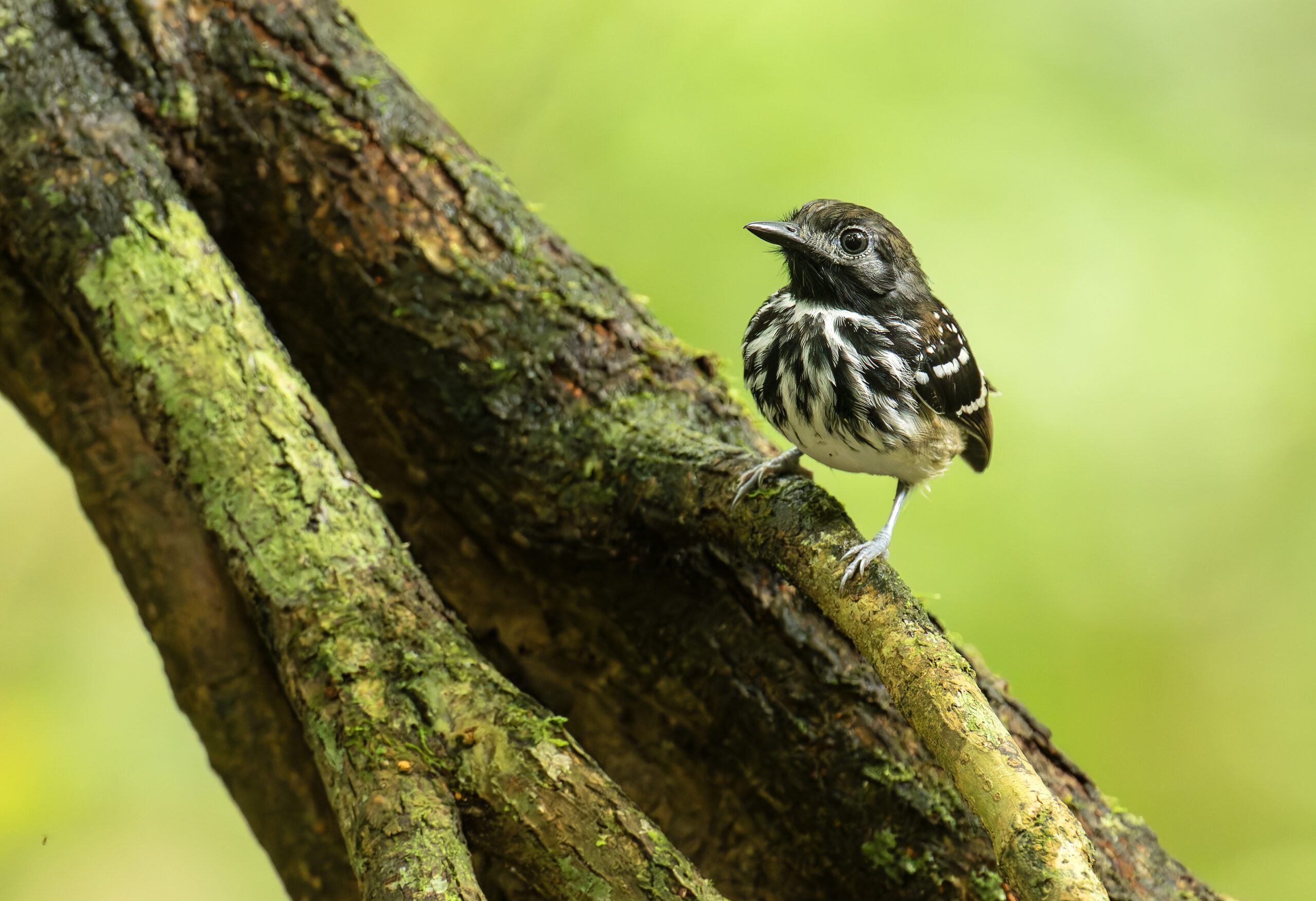
We finished the day with a birding walk along the trails of Muyuna Lodge with Fransisco. We were keen on finding more specialist species of this part of the Amazon. A nice pair (male and female) of Dot-backed Antbirds granted us with very good views. We also found a flock of birds and although they were high up in the trees, we could add some new species to our list: Olivaceous Woodcreeper, Amazonian Plain-Xenops,Cinnamon-rumped Foliage-gleaner, Eastern Woodhunter. Speckled Spinetail, Dwarf Tyrant-Manakin and 2 woodpeckers (Crimson-crested Woodpecker, Chestnut Woodpecker) were also present.
Another tasty dinner in the cozy dining area, where the guests share the long tables, followed by a good night sleep.
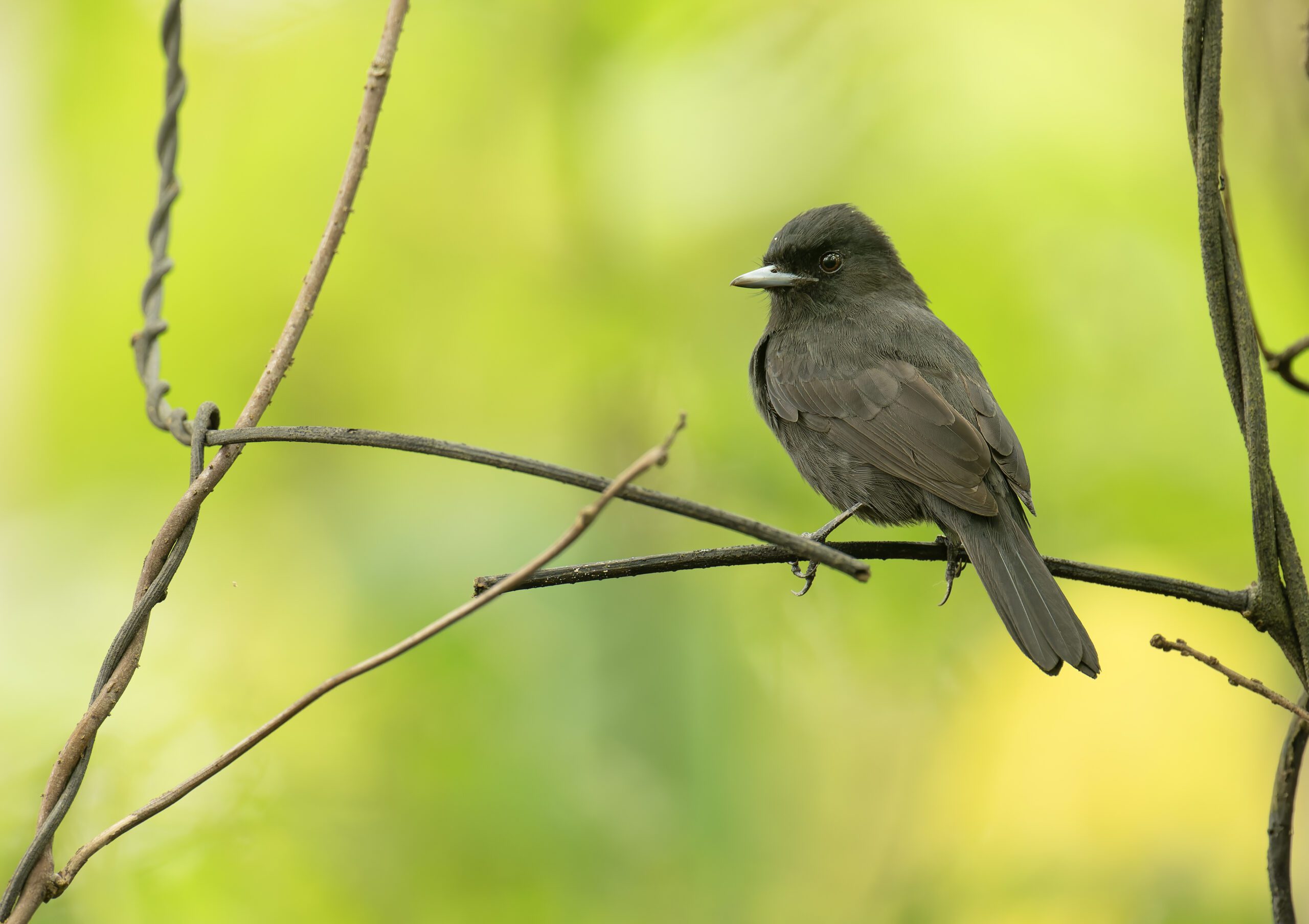
13 February – Another boat ride on the program for this morning. The river that we visited, was completely covered with the aquatic plant Pistia, also appropriately called water cabbage. Our boat driver had to put the boat several times in reverse to get rid of water plants that got stuck in the outboard motor. It worked very well. We came across interesting species, like Anhinga, Rufescent Tiger-Heron, Scarlet-crowned Barbet, Mealy Amazon,Rose-fronted Parakeet, Varzea Schiffornis, Cinnamon Attila, and a Horned Screamer mother with a small yellow chick. On our way back, we saw a Horned Screamer nest close to the boat with 3 with egg, no parents in sight and one egg were hatching! A small wet chick forced its way out of the eggshell. What a beautiful moment! We enjoyed it for some minutes and then left the chick in peace, wishing it good luck and hoping it will be able to grow to adulthood with so many predators lurking around.
In the afternoon we explored the forest around Muyuna again and finally had the pleasure to see a family of Eastern Pygmy Marmosets. They were playing hide and seek on the trunk of a big Ceiba Tree, so it seemed. Pygmy marmosets are the smallest monkeys in the world. A full-grown pygmy marmoset could fit in an adult human’s hand, and it weighs about as much as a stick of butter. Birdwise, we saw some species we had already seen in the previous days, like Blue-cheeked Jacamar and the pretty Wire-tailed Manakin. We heard a Black-banded Crake calling but unfortunately couldn’t detect it.

14 February – On our last morning at Muyuna, we visited the big river island Buenos Aires, located in the middle of the Amazon River. This island is covered with forest and big in seize. We disembarked the boat and explored the forest walking. We found a pair of the attractive Ash-breasted Antbirds and a Dugand’s Antwren, among some other more common species.
On our way back, Steve spotted a beautiful Fork-tailed Flycatcher, a migratory species from Southern America in a scrub close to the water side on one of the smaller islands.
In the afternoon, Muyuna’s fast boat brought us back to the other side of the Amazon River, where a van was waiting to bring us back to our hotel in Iquitos.
For the ones among us who visited Muyuna and this area of the Amazon for the first time, it really rained lifers! It was a fantastic experience for our bird lists as well as for senses: the seize of the majestic Amazon River, its many tributaries and lakes, the green and dense jungle with its unpreceded wildlife, the unique river islands, the forest smell in our nostrils, the humidity wrapped around us like a blanked, the heavy rain showers, and the impressive number of hungry mosquitos!
All praise to Muyuna Lodge, for making our stay unforgettable. From the small welcome gift (a little pink river dolphin key chain) that we already received in our hotel in Iquitos, the transfer by car and boat, the fantastic food in the lodge, the beautiful wooden cabins and excellent local guide and boat drivers.
Would you like to come with us to this unique part of the Amazon? During our 12-days Amazon River Birding Tour we will go the places that we talked about in this trip report, as well as the ACTS Field Station located in a terra firme ecosystem at the north bank of the Amazon River, that we didn’t visit during this trip. Contact us if you would like to see the detailed itinerary and prices.
Written by Eva Wu – Photos: Steve Sanchez & Eva Wu
References:
Kuntur Nature and Adventure EIRL
Company Address: Av. Industrial Conj. Hab. FOVIPOL. Nr 104 – Santiago – Cusco – Peru
By using this website, you agree to our use of cookies. We use cookies to give you the most relevant experience and to help our website run effectively.